
SSE (Security Service Edge) is the security subset of the SASE (Secure Access Service Edge) architecture. It provides secure web and application access for users anywhere, on any device, while keeping sensitive data safe.
SSE Benefits
SSE offers numerous benefits to organizations of all sizes, including improved security posture, network performance, and agility. It provides comprehensive protection against a wide range of threats, reduces complexity, and cuts costs. SSE is ideal for cloud-centric environments but can also be used in hybrid infrastructures with on-premises or agent-based components. Some of the benefits of SSE over traditional network security include:
- Improved security: SSE provides comprehensive security protection against a wide range of threats, including malware, phishing, data leakage, and unauthorized access, by adopting the zero trust model.
- Reduced complexity: SSE consolidates multiple security functions into a single, integrated solution, making it easier to deploy and manage security.
- Increased agility: SSE is cloud-based and can be scaled quickly to meet changing business needs.
- Reduced costs: SSE can help to reduce security costs by eliminating the need to purchase and maintain multiple security solutions.
SSE vs SASE
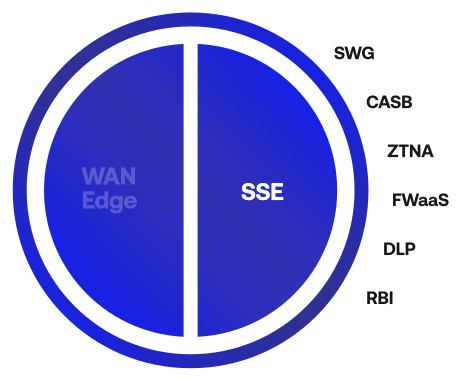
SSE and SASE are both cloud-native security solutions, but they differ in their scope. SASE converges networking and security into a single platform, while SSE is the security subset of SASE. SSE unifies security elements such as SWG, ZTNA, CASB, and FWaaS, while the WAN Edge part of SASE focuses on networking aspects such as SD-WAN, WAN optimization, and QoS.
Core Elements of SSE
The core elements of SSE are:
- Secure Web Gateway (SWG): Inspects and filters web traffic to protect users from malicious websites, malware, and other threats.
- Cloud Access Security Broker (CASB): Monitors and controls access to cloud applications and data to prevent unauthorized access, data leakage, and other security risks.
- Zero Trust Network Access (ZTNA): Verifies user identity and device security before granting access to applications and data to protect against unauthorized access, even from within the corporate network.
- Data Loss Prevention (DLP): Prevents sensitive data from being leaked or lost.
- Remote Browser Isolation (RBI): Isolates web browsing sessions from the endpoint to protect against malware and other threats.
- Firewall-as-a-Service (FWaaS): Provides network firewall protection to cloud workloads.
Top Considerations When Adopting at a SSE Solution
Choosing a SSE solution is a serious decision, both from a business and technical perspective. SSE solutions can have a significant impact on your organization's network, security, and overall infrastructure. As such, it is important to carefully consider all of your options before making a decision.
- Security features: SSE solutions offer a variety of security features, such as Secure Web Gateway (SWG), Cloud Access Security Broker (CASB), and Zero Trust Network Access (ZTNA). It is important to choose an SSE solution that offers the security features that you need to protect your organization.
- Scalability: SSE solutions should be scalable to meet the needs of your growing organization.
- Integration: SSE solutions should be able to integrate with your existing network and security infrastructure.
Conclusion
In summary, SSE is a comprehensive security framework that can help organizations improve your security posture, regardless of whether you have immediate plans to adopt SASE. SSE solutions can be deployed in a modular fashion, allowing organizations to start with the elements that you need most and add more elements as needed. When choosing an SSE solution, it is important to do thorough research and to consider the specific needs of your organization. You may also want to connect with a multi-vendor integrator who can help you choose and deploy the right solution for your needs.
We are committed to helping organizations create a more secure digital world. For more information on cybersecurity safety, please visit the National Cybersecurity Alliance website: National Cybersecurity Alliance website.
Our top cybersecurity resources:

Alex Cronin
Hardware Nation
Tel. 770.924.5847
LinkedIn | GitHub
Alex Cronin is the founder of Hardware Nation and Nanites AI. He is a graduate of Georgia Tech with 20 years of experience in networking and data center infrastructure across enterprises, service providers and hyperscalers. His work spans traditional and open networking, production SONiC deployments, multivendor integration and direct collaboration with manufacturers and engineering teams. Hardware Nation has served organizations including NASA, Lockheed Martin, Accenture, Stanford University and Georgia Tech.
Alex leads engineering teams and contributes directly to architecture, code, integration and evaluation. At Nanites AI, he has led nearly two years of development of an agentic NetOps platform for network troubleshooting. He also develops AI automation for product research and leads business operations at Hardware Nation.
Nanites AI has been cited in Gartner’s Market Guide for Agentic NetOps Software, covered by InformationWeek and discussed by Cisco DevNet. It was selected as one of 12 finalists from more than 400 applicants in the 2025 T Challenge, organized by T-Mobile and Deutsche Telekom. Alex has presented his work at Deutsche Telekom in Bonn, CableLabs and Network X Americas.