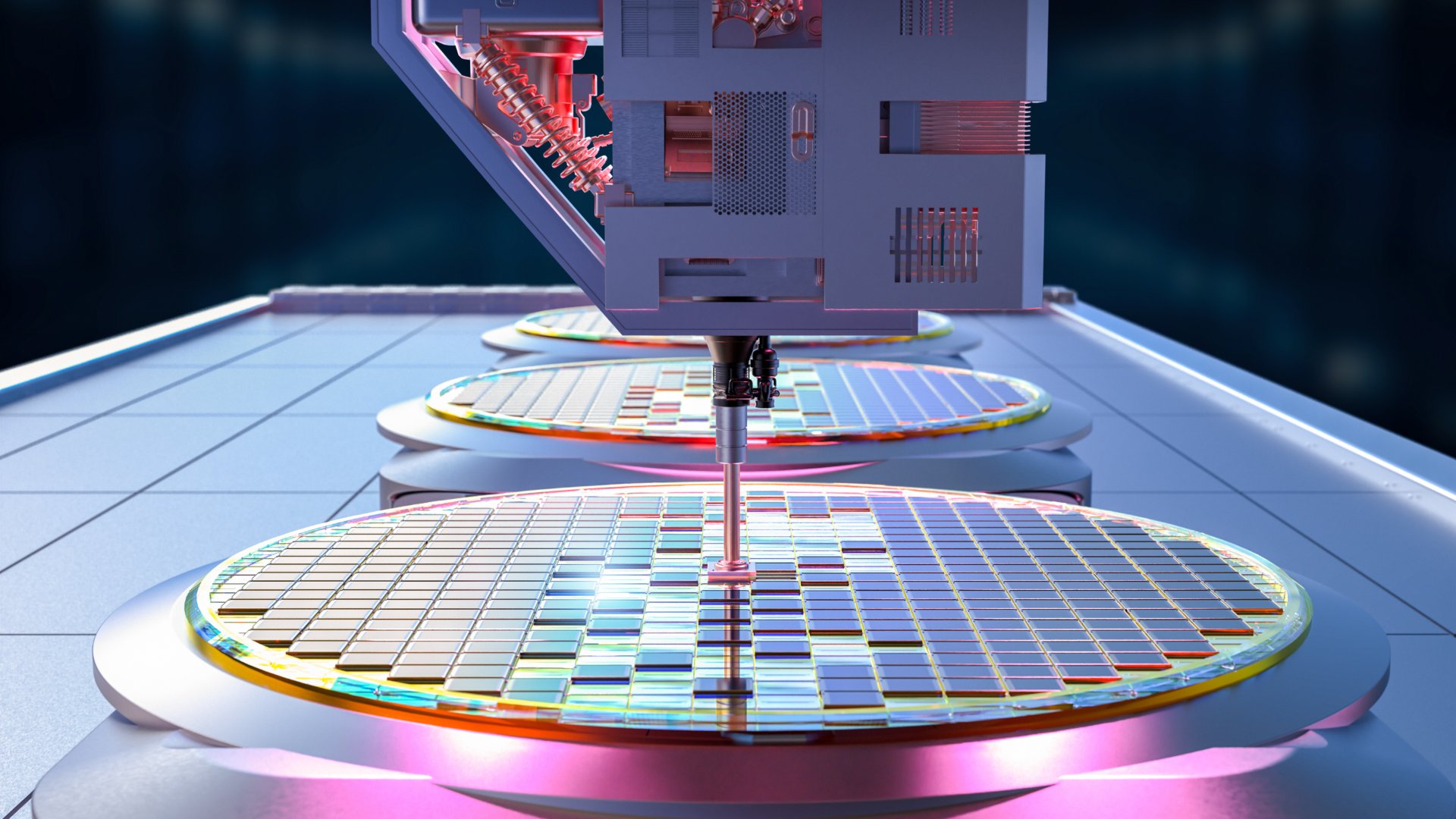
Broadcom’s Tomahawk 4 and Trident 4 are both highly constrained. Vendors are telling us that will not change until the second or third quarter of 2027. A network team that needs these switches before then may have to qualify another switch or delay the deployment. On October 19, SemiAnalysis warned that memory and logic could become the largest constraint in 2027 and 2028 as more data centers get built.
Switch Chips Share Processes With AI Accelerators
Broadcom’s Tomahawk 4 provides 25.6 Tbps on a 7nm process. Trident 4 targets enterprise and campus networks with up to 12.8 Tbps on 7nm. Tomahawk 5 provides 51.2 Tbps on 5nm, while Tomahawk 6 reaches 102.4 Tbps on TSMC’s 3nm N3 process family.
In March, SemiAnalysis estimated that AI accelerators, host processors and networking chips would take just under 60% of TSMC’s N3 output in 2026 and 86% in 2027. Tomahawk 6 and NVIDIA Spectrum 6 are among the networking chips it counted.
TSMC is converting some 5nm tools to support 3nm production in Tainan, while adding new 3nm fabs. It plans production at a new fab there in the first half of 2027 and at its second Arizona fab in the third quarter.
Why AI Memory Affects Network Switches
Edgecore’s AS9736-64D has a Tomahawk 4 ASIC alongside an Intel Xeon D control processor, 32GB of DDR4 memory and a 128GB SSD. If any one of those parts is late, the switch ships late.
Gartner’s Jon Forest expects memory to account for up to 25% of network hardware expense by the end of next year. In August, Gartner said enterprise network equipment prices would rise more than 20% in 2026 and would not come down before the end of 2027.
High-bandwidth memory (HBM), used with AI accelerators, competes with conventional DRAM for wafer production. SemiAnalysis estimates that HBM uses about three times as much wafer capacity per bit as commodity DRAM.
Average prices for 4Gb DDR4 chips rose more than 20% month over month in March 2026, following major suppliers’ 2025 announcements that some legacy-node products would reach end of life. DDR4 is the memory generation used in the Edgecore switch above.
Cloud providers are buying more flash storage. TrendForce expects enterprise SSD demand to grow more than 80% in 2026, with most additional output already committed. It also expects fourth-quarter contract prices to rise 10 to 15% for conventional DRAM and 15 to 20% for NAND flash.
Optics and Boards Require Specialized Materials
An electro-absorption modulated laser (EML) combines a laser and modulator on an indium phosphide chip. The laser produces light and the modulator changes it in response to electrical data. Lumentum’s technical explanation uses an 800G transceiver built with eight 100G EMLs as an example.
Filling 64 ports on a 51.2 Tbps switch with that module design would require 512 EML chips at the switch alone. The module maker has to obtain all of those lasers as well as the other components before the links can be installed.
Broadcom makes both EMLs and continuous-wave (CW) lasers. CEO Hock Tan said on September 2 that “demand for lasers, whether it’s EML lasers, CW lasers, is far surpassing supply out there in the industry.”
Lumentum said in August that certain component shortages were holding shipments below what customers wanted. It expected EML deliveries to fall well short of customer demand at the end of 2026. It was expanding its two indium phosphide fabs in Japan, with additional output from its new Greensboro fab expected from early 2028.
Unimicron’s chairman identified tight supplies of low-expansion glass cloth, copper-clad laminates and Ajinomoto Build-up Film (ABF) package material at October’s Taiwan Printed Circuit Association show, TrendForce reported. Intel also reported substrate, memory and other component shortages affecting data center processors into 2027.
Switch Makers Are Ordering Parts Earlier
Arista had $11.4 billion in non-cancellable purchase commitments at September 30, including $2.1 billion with delivery dates more than a year out. The company links those purchases to AI deployments and the semiconductor shortage. Changing the quantities or rescheduling deliveries requires the supplier’s agreement.
Arista purchase commitments by quarter
2024Q4
2024Q1
2025Q2
2025Q3
2025Q4
2025Q1
2026Q2
2026Q3
2026
Purchase commitments at the end of each quarter, in billions of US dollars. Data from Arista’s quarterly and annual SEC filings.
HPE’s data center networking revenue fell 6% because supply constraints changed shipment timing, CFO Marie Myers said in September. HPE has increased inventory commitments, signed multiyear agreements and offered alternative product configurations.
Tan said Broadcom had secured enough parts and manufacturing to double AI semiconductor revenue to approximately $115 billion in 2027. “Our demand actually exceeds this outlook,” he added. That business includes custom accelerators as well as networking, with leading-edge wafers, substrates and HBM among the required inputs.
Cisco has raised its forecast for AI infrastructure revenue from hyperscalers to $9 billion in fiscal 2027. The November 12 results put that figure at more than double the fiscal 2026 total. Those systems need the same types of memory, optics and boards that are under pressure elsewhere in the industry.
Forecasting Purchases Before Projects Are Approved
Our vendors are requesting forecasts, and enterprise customers are not always able to provide them. A hyperscaler planning several data center buildouts can make purchases years ahead. Micron has 26 long-term agreements backed by $32 billion in customer commitments, mostly cash deposits. An enterprise may still be waiting for approval of the project that determines how many switches it will buy.
Forest recommends rolling 12- to 24-month forecasts and early discussions about constrained components. An approved refresh can be listed separately from a proposed expansion, with quantities revised as projects become clearer.
The last shortage also produced orders well beyond immediate requirements. Gartner recorded networking lead times as long as 400 days in 2022, while SemiAnalysis’s history of the pandemic memory cycle records widespread duplicate and triplicate ordering. Suppliers had difficulty separating the equipment customers actually needed from orders placed to protect against delays.
Qualifying Another Switch Takes Time
Gartner’s Andrew Lerner recommends ordering early, considering a wider mix of port counts and speeds, and looking at certified refurbished equipment. A smaller switch may fit part of the design, but the optics, cabling and automation still have to work with it. A spare has to support the configuration and software running on the switch it would replace.
Replacing one 64-port switch with two smaller switches can change rack space and power requirements. The complete design may include more links between switches, with additional ports used for those connections.
Running the same network operating system across several manufacturers’ switches can make it easier to move to other silicon when the preferred platform is unavailable. SONiC offers that common base, although its Switch Abstraction Interface (SAI) implementation and SDK remain specific to the ASIC. The replacement still has to be qualified, including congestion tests with the NICs used in an AI fabric or checks of EVPN functions and routing scale in an enterprise network.
When Switch and Memory Shortages May Ease
In May, Lerner predicted that enterprise data center switch prices would rise 15 to 40%, with delivery times of three to nine months, up from one to two months in mid-2025. He expected constraints to ease around mid-2027. That was before the memory makers said in September and October that supply would stay tight through 2027 and 2028.
Dell’Oro Vice President Sameh Boujelbene expected the AI back-end switch market to remain supply constrained for at least another one to two years in its September outlook. These switches connect accelerated servers, and their sales had overtaken front-end sales for the first time in the second quarter of 2026.
SK hynix expects memory demand to exceed production through 2030. In October, it said long-term agreements already covered more than half its output for 2027 and 2028.
Micron expects DRAM and NAND to remain constrained through 2028, with initial wafer output from its first Idaho fab scheduled for mid-2027. Its second Idaho fab follows in late 2028, and its Singapore NAND plant is scheduled to begin output in the second half of that year. The company says meaningful production from new fabs follows the first wafers by several quarters.
What This Means for a 2027 Refresh
For a 2027 refresh, the switch and its optics may have different delivery dates. The installation window has to allow for the complete configuration to arrive and be tested, even if industry lead times are starting to shorten.
Adding ports for new servers may have a fixed installation date, while replacing working switches to standardize the hardware can be more flexible. That can change whether a team orders an already qualified substitute or waits for its preferred platform.

Alex Cronin
Alex Cronin is the founder of Hardware Nation and Nanites AI. He is a graduate of Georgia Tech with 20 years of experience in networking and data center infrastructure across enterprises, service providers and hyperscalers. His work spans traditional and open networking, production SONiC deployments, multivendor integration and direct collaboration with manufacturers and engineering teams. Hardware Nation has served organizations including NASA, Lockheed Martin, Accenture, Stanford University and Georgia Tech.
Alex leads engineering teams and contributes directly to architecture, code, integration and evaluation. At Nanites AI, he has led nearly two years of development of an agentic NetOps platform for network troubleshooting. He also develops AI automation for product research and leads business operations at Hardware Nation.
Nanites AI has been cited in Gartner’s Market Guide for Agentic NetOps Software, covered by InformationWeek and discussed by Cisco DevNet. It was selected as one of 12 finalists from more than 400 applicants in the 2025 T Challenge, organized by T-Mobile and Deutsche Telekom. Alex has presented his work at Deutsche Telekom in Bonn, CableLabs and Network X Americas.